
Sub-pages: │ Welcome │ Reports │ Contacts │ Links │ Yellow-legged Asian hornet │

Click HERE to sign up for Beginners course 2026
NEW BBKA WEBSITE
BBKA Website (https://www.bbka.org.uk/)
A new BBKA website will go live next week (week beginning 1st December). The updated site is designed to offer improved navigation and engaging content for the general public seeking information on honey bees, beekeeping, the Yellow-legged Asian Hornet and honey.
We’ve also streamlined how you access member-only information. The dedicated ‘Beekeepers’ area on the old website has now been retired, and all member exclusive resources have been relocated to our learning platform. This change ensures that materials are securely available to members only, as the new website itself does not support restricted access.
BBKA Learning Online (Member Hub) (https://learning.bbka.org.uk/)
The learning platform will be renamed ‘BBKA Member Hub’ to coincide with the launch of the new redesigned website.
Registered, Partner, School, Junior and Honorary Members can access the ‘Member Hub’ using their membership number and postcode and it will remain the main platform for beekeeping resources and training materials.
There are currently nine main sections on the Member Hub:
Latest News and Events: Calendar of Events (including Association events), Monthly Highlights, Summary of New Content and Member Feedback Form.
Resources for Members: Wide selection of resources and learning blocks covering all topics including Beekeeper Training (includes GH26), Honey & Hive Products, Module Study, The Beekeeping Year and Zoom Talks.
Yellow-legged Asian Hornet: Information for YLAH Teams & Awareness Resources
Exams & Assessments: General Exam Information, Syllabi & Information Packs, Reading Lists & Module Past Papers
Resources for Association Officers: Training resources for use by Associations. Please note this section is only accessible by Association Officers using a previously supplied password (enrolment key).
BBKA News Magazine Archive: Digital copies of BBKA News going back to 2020.
Correspondence Courses: Paid courses with an assigned tutor, offered in six-month blocks which need to be purchased via the website shop. Free of charge module study units (without an assigned tutor) are available under ‘Resources for Members’ at any time.
Association Area: Information shared by Associations.
Admin & Compliance: ADM Documents, Association Resources, Insurance Documents, Polices & Risk Assessments.
If members experience problems logging into the Member Hub or need additional help, they should email bbka@bbka.org.uk or call 024 7669 6679.
Kind regards,
Diane Drinkwater
BBKA Chair
Notice Board
New varroa mite calculator
The new, updated varroa mite calculator is super easy to use!
Click the link HERE and put it in your favourites.
Latest update
December Social 25
Education page
AGM 06 11 25
Solitary Bees Oct ’25
Winter preparation ’25
Quick click to visit:
Contacts – Maps – BuzzMail – Next meeting – Facebook
Bees for Development – Achieving long-term impact in Ghana
Reports
December Social 25
AGM 06 11 25
Solitary Bees Oct ’25
Winter preparation ’25
Honey Processing ’25
Varroa Update ’25
I-Spy June ’25
Improvers Days 2025
Wax moth in the hive
When Asian hornets come to Devon
Weather and bees Feb ’25
Better season Jan ’25
Insulating hives Oct 24
Swarm Control 27/4/24
Cut-outs and queen marking
Island Beekeeping Mar ’24
Keep Calm, Feb ’24
Winter Social-Tips and Tricks
Bee Microbiome 10/23
New solitary bee species in UK
The European orchard bee, Osmia cornuta, has established itself in southern England. First spotted in London in 2014, warmer spring weather enables this continental bee to survive our climate. Read about it HERE
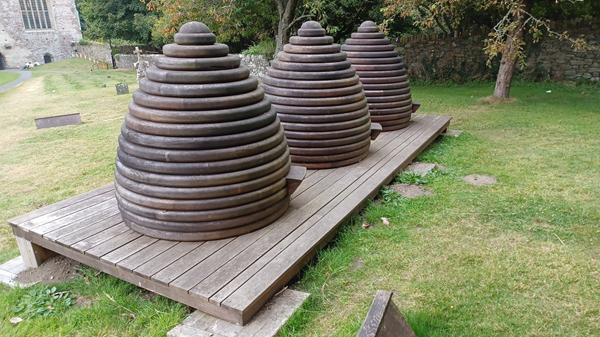
Myths, legends, artists and giant bee hives in St David’s, west Wales. Read about the project at Ancient Connections
Planting 150 Year Anniversary Trees

To commemorate their 150th anniversary the BBKA kindly funded a tree for East Devon Beekeepers to plant. We chose a lime tree to provide good forage for our bees at the beeshed and for other local insects. It is planted adjacent to the club hives. Pictured planting the tree are our President Hilary Kirkcaldie, our youngest member Harry Burrough (16) and Mandy Wiscombe the widow of our oldest member, David Wiscombe, who sadly passed away in December 2024 aged 91.

For over 60 years David served the branch with great dedication as a mentor to anyone needing support, as well as, at various times, holding the offices of Apiary Manager, Chairman and President. We hope our youngest member will come back to see the tree on the 200th Anniversary of BBKA! We also hope that the tree fares well with the present challenges facing our environment and becomes a beautiful feature of the local landscape.
See the entry on the BBKA website.
You can help pollinators by planting suitable trees or bushes near your apiaries. Plants in this list of suggestions are known to grow well in most East Devon soils and are available in many Garden Centres.

Mahonia – lots of varieties to choose from. Flowers early in the year with bright yellow flowers producing nectar and pollen. Beautiful scent. Can grows to 20ft or more.
Skimmia – usually a ground-hugging shrub with evergreen leaves. Flowers from February to April. Very attractive to honey bees when in full sun. Also has an attractive scent. Tolerates shaded areas.


Viburnum tinus – has small, pink flowers suitable for honey bees to collect nectar in the early part of the year. A much-grown ornamental shrub.
Sarcococcus or winter box – a winter flowering plant with small white flowers that have an amazing scent, very attractive to honey bees.


Mimosa – flowers from February to April. Fills the garden with a sweet scent and the sound of buzzing bees. Grows quickly to 30ft or more.
Sub-pages: │ Welcome │ Reports │ Contacts │ Links │ Yellow-legged Asian hornet │
© 2026 East Devon Beekeepers
Queen marking colour for 2026 – White
The International queen marking colour code:
Years ending 1 or 6 are White , 2 or 7 are Yellow, 3 or 8 are Red, 4 or 9 are Green, 5 or 0 are Blue
Remember with the mnemonic Why You Rear Good Bees.